S corp reasonable compensation is the salary an S corporation must pay a shareholder who works in the business before it makes non-wage distributions to that shareholder. It should roughly match what the company would pay an unrelated person for the same services. The IRS publishes no formula or percentage; courts weigh duties, hours, experience and market pay, and they recharacterize distributions as wages when the salary is too low.
Key takeaways
- The IRS says an S corporation must pay reasonable compensation to a shareholder-employee for services before non-wage distributions may be made to that shareholder.
- There is no safe harbor, fixed percentage or "60/40 rule"; reasonable compensation is a facts-and-circumstances judgment, and courts lean on market pay for similar work.
- In David E. Watson, P.C. v. United States (8th Cir. 2012), a CPA paid $24,000 a year while his corporation received about $200,000 a year in profit distributions had $91,044 a year treated as wages.
- For 2026, Social Security tax applies to wages up to $184,500, so every dollar shifted from distributions to salary below that base carries 15.3% in combined payroll tax.
- A written file showing duties, hours, market data and the method used is the best defense, and it should be refreshed every year.
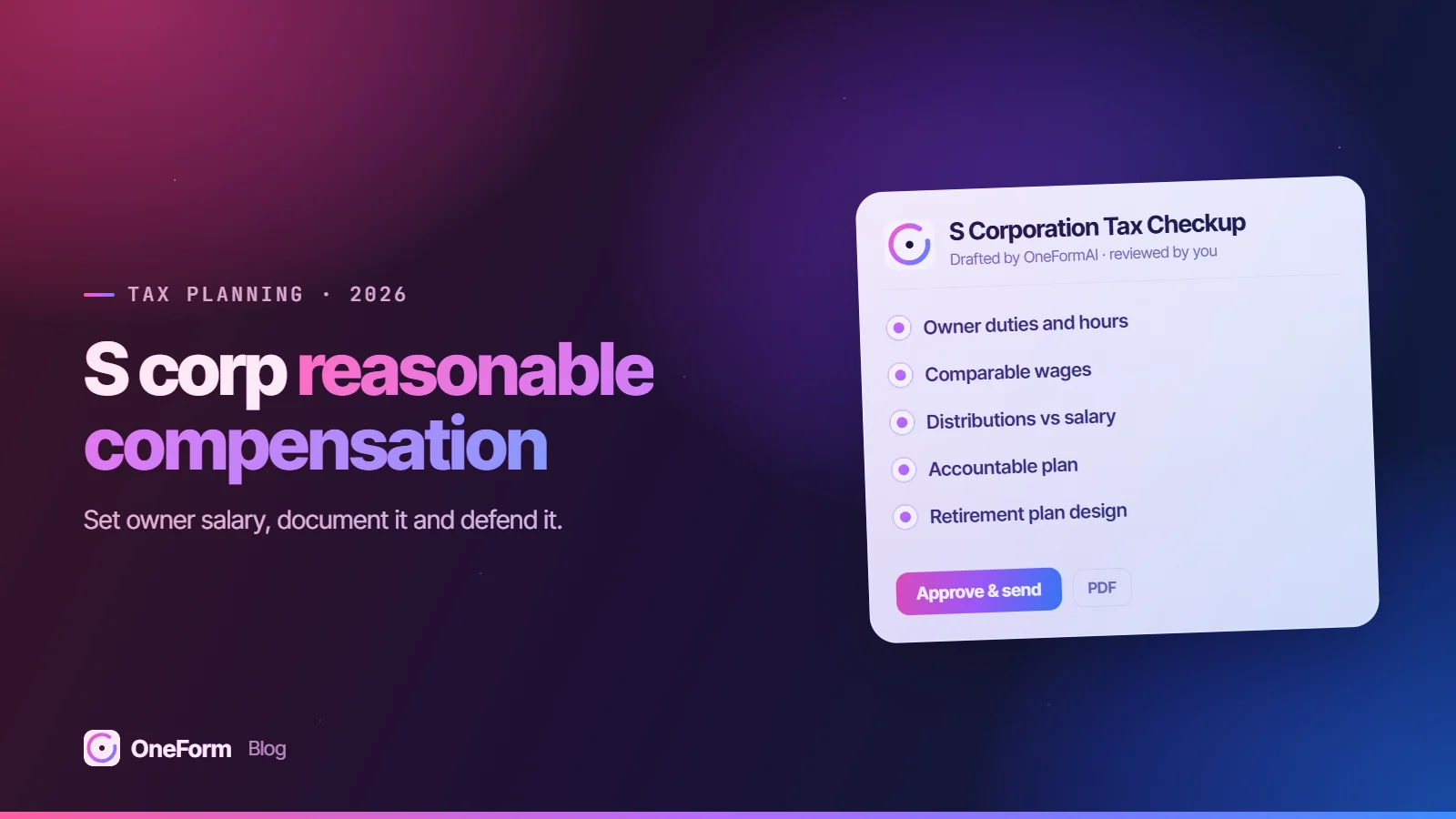
Run this conversation in OneForm. The S Corporation Tax Checkup template gathers the owner's facts, and OneFormAI drafts a findings report from each response that you review before it reaches the client. Start free, no card needed.
What is reasonable compensation for an S corp owner?
Reasonable compensation is the amount an S corporation would have to pay, in an arm's-length hire, for the services its shareholder-employee actually performs. Corporate officers are employees for FICA, FUTA and income tax withholding, and being a shareholder does not change that, according to the IRS.
The obligation is triggered by money leaving the company. If a shareholder received or had the right to receive cash or property, the corporation must determine and report a reasonable salary. An officer who performs no services, or only minor services, and is not entitled to compensation is not treated as an employee.
The IRS frames the analysis around where gross receipts come from. To the extent receipts are generated by non-shareholder employees or by capital and equipment, payments to the owner can be non-wage distributions. To the extent they come from the shareholder's personal services, payments should be wages (IRS, S corporation compensation and medical insurance issues). That framing explains why a solo consultant's salary should be a much larger share of profit than the salary of an owner with 20 employees.
What factors does the IRS use to judge reasonable compensation?
The IRS lists the factors courts have used:
- Training and experience
- Duties and responsibilities
- Time and effort devoted to the business
- Dividend history
- Payments to non-shareholder employees
- Timing and manner of paying bonuses to key people
- What comparable businesses pay for similar services
- Compensation agreements
- The use of a formula to determine compensation
The IRS's 2014 Reasonable Compensation Job Aid for IRS Valuation Professionals shows how examiners turn those factors into a number. It is not an official IRS position and cannot be cited as authority, but it is the clearest view of how an exam will approach the file.
| Approach | Question it answers | Where it fits | Weakness |
|---|---|---|---|
| Market | What would a non-owner in the same position earn at a similar company? | Most used; the Job Aid says reconciliation "will generally rest heavily" on it | True comparables are hard to find for small firms |
| Income (independent investor test) | After paying this salary, would an outside investor be satisfied with the return? | Larger companies with a known fair market value | Needs a valuation for each year; book equity is a poor proxy |
| Cost ("many hats") | What would it cost to replace each role the owner fills, by hours? | Owners who split time across sales, operations, bookkeeping and technical work | Hard to allocate time; adding full-time salaries for each role overstates the result |
What do the court cases say about S corp owner salary?
Watson v. United States (8th Cir. 2012)
David Watson was a CPA with an advanced degree and nearly 20 years of experience who worked 35 to 45 hours a week at an accounting firm with gross earnings over $2 million in 2002 and nearly $3 million in 2003. His S corporation paid him $24,000 in salary in each year, while it received $203,651 (2002) and $175,470 (2003) in profit distributions from the firm.
The government's expert used the AICPA's Management of an Accounting Practice survey: a non-owner director earned about $70,000, owners billed about 33% more, so he set owner-level pay near $93,000 and adjusted it to $91,044 for fringe benefits. The court adopted that figure, found wages understated by $67,044 a year, and held that substance controls over the label the taxpayer chose (opinion, No. 11-1589).
Sean McAlary Ltd. v. Commissioner (T.C. Summ. Op. 2013-62)
A real estate broker's one-owner S corporation paid no wages and transferred $240,000 to him in 2006. The IRS asserted $100,755 of wages, based on a median $48.44 hourly rate. The Tax Court cut the rate to $40 an hour, or $83,200 a year, citing his limited experience and modest operations (opinion copy). Summary opinions are not precedent, but the method is instructive: market rate times hours, adjusted to the actual person.
Rev. Rul. 74-44
The IRS's long-standing position is that "dividends" paid to shareholders in lieu of reasonable compensation for services are recharacterized as wages, as an IRS information letter summarizes it. Every case since applies the same idea: what matters is what the payment was for.
Is there a 60/40 rule for S corp salary?
No. The 60/40 split (60% salary, 40% distributions) and the 50/50 split are rules of thumb with no basis in the Code, the regulations or IRS guidance. They can be badly wrong in both directions.
A solo professional whose profit comes entirely from personal services may need a salary close to all of profit, up to market pay. An owner whose profit is driven by staff and equipment may support a much lower ratio. Start from the work performed and the source of gross receipts, not from a percentage.
How do you calculate a reasonable salary for an S corp owner?
- List the roles and hours. Write down every role the owner fills (for example, lead consultant, sales, operations, bookkeeping) and the hours per week in each.
- Price each role with market data. Use occupation and metro wage data such as the BLS Occupational Employment and Wage Statistics, plus industry surveys where they exist. Watson turned on an industry survey.
- Weight by hours. Pay for 10 hours of bookkeeping is not a full-time bookkeeper's salary. The Job Aid warns against adding full-time salaries for multiple roles.
- Cross-check the top role. Ask what a non-owner in the owner's main role would earn at a similar company, adjusted for experience as McAlary did.
- Apply the gross receipts test. Identify how much profit comes from the owner's own services versus staff and capital, and make sure the salary covers the first.
- Test against the factors. Compare salary with distributions, pay to non-owner employees, bonus patterns and any prior agreements.
- Run it through payroll. Pay it on a regular schedule with withholding, Forms 941 and a W-2, not as a year-end journal entry.
- Document and revisit. Save the analysis, then update it during each year-end planning round and whenever duties, hours or profit change materially.
How does owner salary affect payroll tax and the QBI deduction?
Salary is subject to Social Security tax of 6.2% each for employer and employee on wages up to $184,500 for 2026 (SSA), plus Medicare tax of 1.45% each on all wages (IRS Topic 751). Distributions carry neither. That 15.3% gap is the whole reason the issue exists.
The QBI deduction pulls the other way for higher earners. Reasonable compensation paid by an S corporation is not qualified business income (IRS), so a higher salary shrinks QBI. But above the 2026 threshold of $201,750 of taxable income ($403,500 joint), fully phased in at $276,750 ($553,500 joint) per Rev. Proc. 2025-32, the deduction is limited to the greater of 50% of W-2 wages or 25% of W-2 wages plus 2.5% of qualified property under section 199A(b)(2). The owner's own wages count toward that limit.
| If the salary goes... | Payroll tax | QBI | Retirement contributions | Exam risk |
|---|---|---|---|---|
| Down | Lower | Higher QBI, but a lower wage limit above the threshold | Less room for contributions based on W-2 pay | Higher |
| Up | Higher, until wages pass the Social Security base | Lower QBI, but a higher wage limit above the threshold | More room | Lower |
Modeling these trade-offs is legitimate planning, but the result still has to fall within a defensible range for the services performed. Health insurance premiums for a more-than-2% shareholder are reported as W-2 wages and may support an above-the-line deduction, per the IRS page linked above.
What documentation should support the salary?
| Document | Who prepares it | When |
|---|---|---|
| Role and hours summary | Owner, reviewed by the firm | Annually and when duties change |
| Market wage data with sources and dates | Firm | Annually |
| Gross receipts source analysis | Firm | Annually |
| Board resolution or minutes setting salary | Owner or corporate secretary | Whenever pay is set |
| Payroll registers, Forms 941 and W-2 | Payroll provider | Quarterly and year-end |
| Distribution schedule and shareholder basis | Firm | Annually |
Collect the owner's inputs during your planning round so the salary review is not a separate chase; our tax planning questionnaire includes the business questions that open the conversation.
How to run this with OneForm
The S Corporation Tax Checkup template asks existing S corporation owners about profit before owner pay, the work they perform, when their salary was last reviewed, how payroll was set, distributions, accountable plans and benefits. For sole proprietors and LLC owners who have not elected yet, Should I Be an S Corporation? screens whether an election is worth modeling.
- Each response produces an AI-drafted report written from your firm's own instructions, so it reflects how you approach reasonable compensation.
- Your team edits and approves every draft before it goes out as a branded PDF, now or on a schedule.
- Workflows can alert your team after each submission and hold the report until it is approved.
Open the S Corporation Tax Checkup to adapt it to your firm's process.
Ready to try it? You can open the S Corporation Tax Checkup template or start free with OneForm. No card needed.
Frequently asked questions
Can an S corp owner take no salary?
Only if the owner performs no services, or only minor services, and is not entitled to compensation. Once a working shareholder receives cash or property from the corporation, the IRS expects a reasonable salary to be determined and paid first. Taking distributions with no wages invites recharacterization, as in Rev. Rul. 74-44 and the McAlary case, plus back payroll taxes, penalties and interest.
Is there a safe harbor percentage for S corp reasonable compensation?
No. Neither the Code, the regulations nor IRS guidance sets a percentage, and the IRS says the answer depends on the facts. Ratios like 60/40 are rules of thumb that ignore what drives profit. A defensible salary starts from the owner's duties and hours, prices them with market data, and accounts for profit generated by staff and capital rather than the owner.
What happens if my S corp salary is too low?
The IRS can reclassify distributions as wages. The corporation then owes the employer and employee shares of Social Security and Medicare tax on the reclassified amount, plus federal unemployment tax, failure-to-deposit and other penalties, and interest. In Watson, $67,044 a year of distributions became wages. A low salary can also reduce the wage base used for retirement contributions and the QBI wage limit.
How do you determine reasonable compensation for an S corp?
List the roles the owner fills and the hours in each, price each role with market wage data, and weight the result by hours. Cross-check against what a non-owner in the owner's main role would earn, and confirm the salary covers profit that comes from the owner's own services. Document the sources and method, run the amount through payroll, and review it every year.
How often should S corp owner salary be reviewed?
At least once a year, ideally during mid-year or pre-year-end planning so payroll can be adjusted before December. Review it sooner when the owner's duties or hours change, the business adds or loses staff, or profit moves sharply. Each review should leave a dated record of the inputs and the reasoning, because that file is what you will rely on in an exam.
This article is general information as of October 2026, not tax or legal advice. Confirm figures and how they apply to each client before acting.