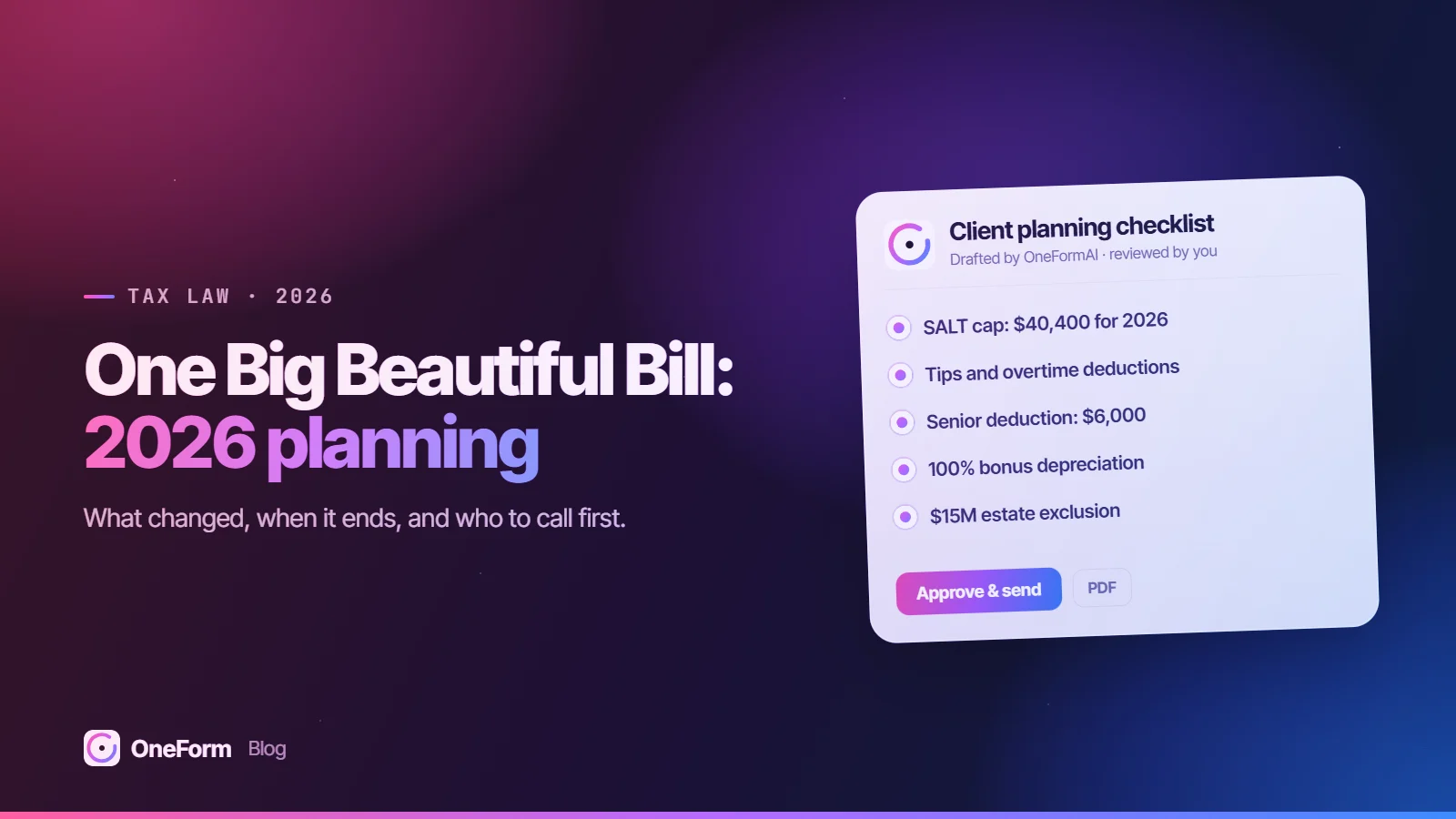
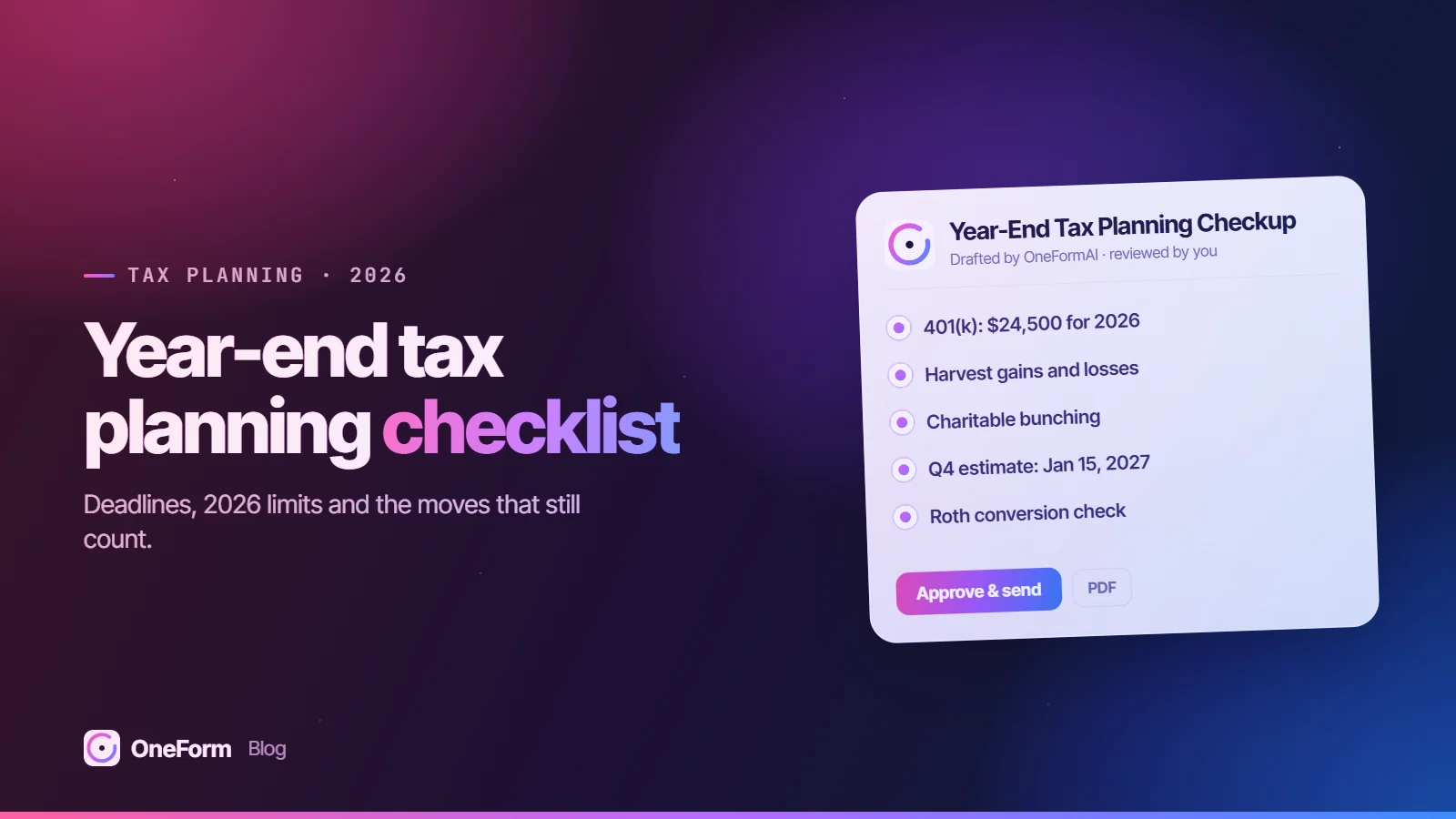
A 2026 year-end tax planning checklist should confirm each client's December 31 moves (retirement deferrals, RMDs and QCDs, charitable gifts, loss harvesting, Roth conversions and equipment placed in service), then the January 15, 2027 estimate and the April 15, 2027 IRA and HSA deadline. This year it must also reflect the One Big Beautiful Bill Act's new charitable floor, 35% itemized-deduction cap and $40,400 SALT cap.
Key takeaways
- For 2026, the 401(k) deferral limit is $24,500, the age-50 catch-up is $8,000, and the catch-up for ages 60 through 63 is $11,250.
- The 2026 IRA limit is $7,500 plus a $1,100 catch-up at 50, and 2026 IRA and HSA contributions can be made until April 15, 2027.
- Starting in 2026, itemizers deduct charitable gifts only above 0.5% of AGI, while non-itemizers can deduct up to $1,000 ($2,000 joint) of cash gifts, which makes bunching and gift timing a year-end decision.
- Clients whose 2025 FICA wages from the plan sponsor exceeded $150,000 must make 2026 catch-up contributions as Roth, so check that their plan offers a Roth option.
- The residential energy credits (25C and 25D) ended after 2025, so buying solar or heat pumps in December no longer earns a federal credit.
Turn this checklist into a client form. OneForm's Year-End Tax Planning Checkup template asks the questions, and OneFormAI drafts each client's year-end action list for your review. Start free, no card needed.
What are the key 2026 year-end tax deadlines?
Most year-end moves have a hard December 31 cutoff: the trade has to settle in the right year, the payroll deferral has to come out of a 2026 paycheck, and equipment has to be placed in service, not just ordered. A handful of contributions can wait until the 2027 filing season, which gives you a second chance to fine-tune once the return is drafted.
| Date | Action | Who it affects |
|---|---|---|
| December 31, 2026 | Last 401(k), 403(b) and 457 payroll deferrals; RMDs other than a first-year RMD; QCDs; charitable gifts; loss and gain harvesting trades; Roth conversions; annual exclusion gifts; equipment placed in service | All clients, business owners |
| December 31, 2026 | Adopt a new 401(k) or other qualified plan if the owner wants it in place for 2026 (the simplest route) | Business owners |
| January 15, 2027 | Fourth 2026 estimated tax payment, unless the client files the 2026 return by February 1, 2027 and pays the full balance | Self-employed, investors, retirees |
| February 1, 2027 | Forms W-2 to employees and to the SSA | Employers |
| April 1, 2027 | First RMD for clients who turned 73 in 2026 (a second RMD is then due by December 31, 2027) | Retirees |
| April 15, 2027 | 2026 IRA and HSA contributions; 2026 Form 1040 or extension; first 2027 estimate | Individuals |
| Return due date with extensions | Set up and fund a SEP for 2026 | Self-employed, small employers |
Sources: 2026 Form 1040-ES, 2026 W-2 and W-3 instructions, the IRS RMD FAQs, Publication 560 and the Form 5498 instructions.
The safe harbor for the January payment still matters. Under the 2026 Form 1040-ES, a client whose 2025 AGI exceeded $150,000 ($75,000 married filing separately) must pay 110% of the 2025 tax, rather than 100%, to avoid an underpayment penalty under the prior-year method.
What are the 2026 contribution limits and key thresholds?
These are the figures most year-end conversations turn on. Each is from the IRS source cited in the last column.
| Item | 2026 amount | Source |
|---|---|---|
| 401(k), 403(b), governmental 457, TSP deferral | $24,500 | IR-2025-111 |
| Catch-up, age 50 and over | $8,000 (total $32,500) | IR-2025-111 |
| Catch-up, ages 60 through 63 | $11,250 | Notice 2025-67 |
| Defined contribution annual additions (415(c)) | $72,000 | Notice 2025-67 |
| SIMPLE IRA / SIMPLE 401(k) deferral | $17,000 | Notice 2025-67 |
| IRA contribution | $7,500, plus $1,100 catch-up at 50 | Notice 2025-67 |
| Roth IRA phase-out | $153,000 to $168,000 single; $242,000 to $252,000 joint | IR-2025-111 |
| HSA contribution | $4,400 self-only; $8,750 family | Rev. Proc. 2025-19 |
| Health FSA salary reduction | $3,400 (carryover up to $680) | Rev. Proc. 2025-32 |
| Dependent care assistance exclusion | $7,500 ($3,750 married filing separately) | 26 U.S.C. 129 |
| Standard deduction | $16,100 single; $32,200 joint; $24,150 head of household | Rev. Proc. 2025-32 |
| Additional standard deduction, 65+ or blind | $1,650; $2,050 if unmarried | Rev. Proc. 2025-32 |
| 0% long-term capital gain rate, up to taxable income of | $49,450 single; $98,900 joint | Rev. Proc. 2025-32 |
| Annual gift exclusion | $19,000 per recipient | Rev. Proc. 2025-32 |
| Estate and gift basic exclusion | $15,000,000 | Rev. Proc. 2025-32 |
| Qualified charitable distributions | $111,000 | Notice 2025-67 |
| Social Security wage base | $184,500 | IRS Topic 751 |
| SALT deduction cap | $40,400 ($20,200 married filing separately) | 26 U.S.C. 164(b)(7) |
| Section 179 expensing | $2,560,000; phase-out above $4,090,000 | Rev. Proc. 2025-32 |
Which One Big Beautiful Bill changes affect 2026 year-end moves?
The One Big Beautiful Bill Act (P.L. 119-21) changed several rules that start in 2026, so last year's year-end playbook needs edits. Our OBBBA planning guide by client type covers the full law. These are the parts that change what clients should do before December 31.
The charitable floor and the non-itemizer deduction
From 2026, an itemizer's charitable deduction counts only to the extent gifts exceed 0.5% of the contribution base (26 U.S.C. 170(b)(1)(I)). A couple with $400,000 of AGI gets no deduction for the first $2,000 they give. Bunching two or three years of gifts into one year, often through a donor-advised fund, absorbs that floor once rather than every year.
Clients who take the standard deduction can now deduct up to $1,000 ($2,000 joint) of cash gifts to qualified charities. Gifts to donor-advised funds and supporting organizations don't count, and noncash gifts don't count (IRS). For these clients, the move is a direct cash gift made by December 31, with a receipt.
The 35% cap on itemized deductions
Starting in 2026, 26 U.S.C. 68 reduces itemized deductions by 2/37 of the lesser of total itemized deductions or taxable income above the start of the 37% bracket ($640,600 single, $768,700 joint for 2026). A client fully in the 37% bracket therefore gets about 35 cents of benefit per deduction dollar. Deferring a dollar of income still saves 37 cents, so for these clients, income timing is worth slightly more than deduction timing.
The SALT cap and its phase-down
The 2026 SALT cap is $40,400, reduced by 30% of modified AGI above $505,000, and never below $10,000. The cap rises 1% a year through 2029 and returns to $10,000 in 2030. For a client with large state taxes, MAGI between $505,000 and roughly $606,333 is a band where each extra dollar of income also removes 30 cents of SALT deduction.
Year-end planning in that band means deferring bonuses or gains where possible, maximizing pre-tax deferrals, and reviewing whether a pass-through entity tax election makes sense for owners. Clients well below the threshold who have been taking the standard deduction should rerun the itemize-or-not comparison, since a $40,400 cap changes that answer for many homeowners in high-tax states.
Clean-energy credits that ended
The energy efficient home improvement credit (25C) ended for property placed in service after 2025, and the residential clean energy credit (25D) ended for expenditures after 2025. The clean vehicle credits ended for vehicles acquired after September 30, 2025 (IRS). A client planning a December solar installation or EV purchase should do it for its own economics, not for a federal credit.
The Roth catch-up rule for higher earners
Under SECURE 2.0, catch-up contributions by employees whose prior-year FICA wages from the plan sponsor exceed a threshold must be designated Roth. Notice 2025-67 sets that threshold at $150,000 of 2025 wages for 2026 catch-ups. The final regulations generally apply from 2027, and plans may follow a reasonable, good-faith reading of the statute for 2026.
At year-end, confirm that affected clients' plans offer Roth deferrals, and adjust projections: a Roth catch-up doesn't reduce 2026 taxable income, which matters for clients managing MAGI around the SALT or senior-deduction thresholds.
The temporary deductions
The tips, overtime, car loan interest and senior deductions run from 2025 through 2028. For clients who qualify, check Form W-4 withholding so they aren't overpaying all year, confirm their employers will report tips (box 12 code TP) and overtime (box 12 code TT) on 2026 Forms W-2, and keep the VIN and loan statement for the car loan deduction. The senior deduction phases out above $75,000 of modified AGI ($150,000 joint), so time Roth conversions and gain harvesting with that threshold in view.
What should individual clients do before December 31, 2026?
- Max out workplace deferrals. Confirm year-to-date 401(k) deferrals and raise the final paychecks' election if the client is short of $24,500, plus any catch-up.
- Take RMDs. Clients 73 and older who already took a first RMD must take the 2026 amount by December 31.
- Use QCDs for giving. Clients 70½ or older can send up to $111,000 from an IRA directly to charity. The QCD counts toward the RMD and is excluded from income, so neither the 0.5% floor nor the 35% cap reduces it.
- Decide on bunching. Compare giving this year's and next year's gifts in one year against spreading them, now that the 0.5% floor applies every year.
- Harvest losses or gains. Net capital losses offset gains and up to $3,000 of ordinary income (26 U.S.C. 1211); avoid repurchasing substantially identical securities within 30 days before or after a loss sale (26 U.S.C. 1091). Clients with taxable income below $98,900 joint may be able to realize gains at 0%.
- Model a Roth conversion. Conversions must be completed by December 31. Include the effect on the senior deduction, the SALT phase-down and the 0% capital gain band.
- Make annual exclusion gifts. Up to $19,000 per recipient for 2026, which does not carry over.
- Check estimates and withholding. Project 2026 tax and confirm the 100% or 110% safe harbor before the January 15 payment. Extra withholding in December counts as paid evenly through the year.
- Use or plan FSA balances. The 2026 health FSA carryover is capped at $680 if the plan allows one. During open enrollment, raise dependent care elections to the new $7,500 limit where it fits.
- Review HSA eligibility for 2027. Starting in 2026, bronze and catastrophic marketplace plans are treated as HSA-compatible (IRS Pub. 6079), which may let some clients open or fund an HSA.
Our Retirement & Roth Tax Checkup and Investment & Capital Gains Tax Checkup gather the account balances, basis and income estimates these items need.
What should business owners do before year-end?
- Place equipment in service by December 31. Bonus depreciation is permanently 100% for property acquired after January 19, 2025, and Section 179 allows $2,560,000 for 2026. Decide whether full expensing helps, especially for owners near the QBI thresholds of $201,750 single and $403,500 joint.
- Collect W-9s now. The 1099-NEC and 1099-MISC reporting threshold is $2,000 for payments made after 2025 (Rev. Proc. 2025-32), so fewer vendors need forms, but you need the payment totals to know which.
- Run final S corporation payroll. Owner wages, health insurance reporting and any year-end bonus have to run through 2026 payroll. See our guide to S corp reasonable compensation.
- Pick a retirement plan. Adopting a 401(k) by December 31 is the cleanest path for 2026 deferrals. A SEP can be set up and funded as late as the extended return due date (Pub. 560).
- Review PTET. For owners above the SALT phase-down, an entity-level state tax election can still move state taxes off the owner's Schedule A. Check each state's election and payment deadlines.
- Consider Trump account contributions. Employers can contribute up to $2,500 per employee tax-free under a written Section 128 plan, counting toward the $5,000 annual account limit (IRS).
How to run year-end planning with OneForm
Year-end planning breaks down when the firm has to chase every client for the same facts in November. OneForm lets you send one questionnaire to the list, then turns each response into an AI-drafted report written from your firm's instructions. Your team edits and approves every draft before it goes out as a branded PDF.
- Start from the Year-End Tax Planning Checkup, which uses conditional logic so a retiree never sees payroll questions.
- Set up a workflow that drafts the report, waits for approval, emails the PDF and alerts the preparer.
- Watch report opens and clicks to see which clients read their action items before December.
- Add a booking page so clients with large swings can schedule a call from the report.
To get started, open the Year-End Tax Planning Checkup template and adjust the questions to your client mix. Our tax planning questionnaire guide explains how to decide which questions to keep.
Ready to try it? You can open the Year-End Tax Planning Checkup template or start free with OneForm. No card needed.
Frequently asked questions
What should I do before the end of the year to lower my taxes?
The most common December 31 moves are maxing out 401(k) deferrals through payroll, harvesting capital losses, making charitable gifts or QCDs, completing any Roth conversion, taking required minimum distributions and placing business equipment in service. For 2026, also check whether bunching gifts beats the new 0.5% charitable floor and whether income timing keeps you under the SALT phase-down threshold.
Can I still contribute to an IRA for 2026 after December 31?
Yes. Contributions to a traditional or Roth IRA for 2026 can be made until April 15, 2027, the unextended due date of the 2026 return. Tell the IRA custodian the contribution is for 2026. The 2026 limit is $7,500, plus a $1,100 catch-up for clients age 50 or older. HSA contributions for 2026 follow the same April 15, 2027 deadline.
When is the fourth-quarter 2026 estimated tax payment due?
The fourth 2026 estimated payment is due January 15, 2027. A client can skip it by filing the 2026 return by February 1, 2027 and paying the full balance. To avoid an underpayment penalty under the prior-year safe harbor, pay 100% of 2025 tax, or 110% if 2025 AGI was over $150,000.
Should clients bunch charitable donations in 2026?
Often, yes, for itemizers. Starting in 2026, gifts count only above 0.5% of AGI, so giving two or three years of donations in one year, often through a donor-advised fund, absorbs that floor once. Top-bracket donors also face the 35% cap. Clients who take the standard deduction can deduct up to $1,000 ($2,000 joint) of direct cash gifts each year.
What is the 401(k) contribution limit for 2026?
The 2026 employee deferral limit for 401(k), 403(b), governmental 457 plans and the TSP is $24,500. Employees 50 and older can add an $8,000 catch-up, for $32,500 in total, and those aged 60 through 63 can use an $11,250 catch-up instead. Total employer and employee additions to a defined contribution account are capped at $72,000.
Do I have to take my required minimum distribution by December 31?
Usually. Clients who must take RMDs have to take each year's amount by December 31. The one exception is the first RMD, for the year a client turns 73, which can wait until April 1 of the next year. Delaying it means two RMDs in the same tax year, which can push income into a higher bracket.
This article is general information as of October 2026, not tax or legal advice. Confirm figures and how they apply to each client before acting.