A tax planning questionnaire is a set of questions a firm sends clients before a planning meeting to find out what changed this year and which strategies are worth modeling. The useful ones are organized by life area (income, business, real estate, retirement, investments, family, charitable giving and estate), open with short screening questions, and only ask for detail when an answer points to an opportunity.
Key takeaways
- A tax planning questionnaire looks forward and asks about changes, decisions and intentions; a tax organizer looks back and collects documents for the return.
- Yes/no screening questions with conditional follow-ups let one questionnaire cover every life area while staying short enough for clients to finish.
- Send it at least twice a year (a mid-year check-in and a pre-year-end round in early fall) and again whenever a client reports a major life event.
- Several 2026 figures changed under the One Big Beautiful Bill Act, including a $40,400 SALT cap and a new charitable deduction for non-itemizers, so last year's questionnaire will miss real opportunities.
- Every question should map to an analysis the firm will actually run; if no answer would change your advice, cut the question.
Send these questions as a ready-made form. OneForm's Tax Opportunity Report template asks them one at a time, and OneFormAI drafts a written findings report from each client's answers for you to review and send. Start free, no card needed.
What is a tax planning questionnaire?
A tax planning questionnaire is a forward-looking client form that captures life events, expected income and pending decisions so the preparer can model strategies before the year closes. It is not a tax organizer: the organizer feeds the return, the questionnaire feeds the planning meeting.
Mixing the two is a common design mistake: planning questions buried in an organizer get document answers, not decisions.
| Tax organizer | Tax planning questionnaire | |
|---|---|---|
| Purpose | Prepare an accurate return | Find strategies that change the outcome |
| Time frame | The year that just ended | This year and the next one to three years |
| When sent | January to March | Mid-year and early fall, plus life events |
| Typical question | "Upload all 1099-B forms" | "Do you plan to sell appreciated stock before December 31?" |
| Output | Workpapers and a return | A written plan with prioritized actions |
When should clients complete a tax planning questionnaire?
Timing decides how many strategies are still available. Answers received in February explain what happened; answers received in July can still change withholding, deferrals, entity choice and the timing of a sale.
- Mid-year (June to August): the best window for entity changes, owner salary adjustments, retirement plan setup and estimated tax corrections.
- Pre-year-end (September to October): drives harvesting, charitable bunching, Roth conversions and equipment purchases. Our year-end tax planning checklist covers the December moves.
- Event-triggered: marriage, divorce, a birth, a move, a home or business sale, an inheritance or retirement. A short version sent soon after the event catches decisions before they are made.
What questions should a tax planning questionnaire include?
Use the bank below as a menu, not a script. Ask every client the first question in each area, and show the rest only when that answer is yes. Figures are for tax year 2026, as of October 2026.
Household and life changes
- Did your filing status change this year, or will it before December 31 (marriage, divorce, death of a spouse)?
- Did anyone join or leave your household, including a birth, adoption or a dependent moving out?
- Did you move, or do you expect to move, to another state?
- Did you or your spouse turn 65 this year?
- What big decision are you weighing in the next 12 months (selling a business, retiring, buying a home)?
For 2025 through 2028, taxpayers 65 and older get an additional $6,000 deduction ($12,000 if both spouses qualify), phasing out above $75,000 of modified AGI ($150,000 joint), according to the IRS.
Income
- Is your household income this year higher, about the same or lower than last year?
- Did you receive a bonus, severance, equity compensation (RSUs, ISOs, NSOs, ESPP) or deferred compensation?
- Do you receive tips or overtime pay?
- Did you buy a new car for personal use with a loan taken out after 2024?
- Do you earn income in more than one state?
- Can you control the timing of any income (a bonus, invoices, an installment sale)?
- Have you made estimated payments, and are you confident your withholding is on track?
- Do you have income or financial accounts outside the US?
The tips, overtime and car loan questions are new. For 2025 through 2028, the IRS lists deductions for up to $25,000 of qualified tips, up to $12,500 ($25,000 joint) of overtime premium pay, and up to $10,000 of interest on a loan for a new, US-assembled personal vehicle, each with income phaseouts.
Business and self-employment
- What entity is the business, and when was that choice last reviewed?
- What net profit do you expect this year compared with last year?
- If you own an S corporation, when was your own salary last reviewed, and how was it set?
- Do you plan to buy equipment, vehicles or software before year-end?
- Do you have employees, and do any family members work in the business?
- Does the business sponsor a retirement plan, and is everyone who could contribute doing so?
- Do you pay business expenses personally, and does the business reimburse you under a written plan?
- Do you use a home office or a personal vehicle for business, and do you keep a mileage log?
- Do you expect to sell, merge or close the business in the next three years?
For 2026, the qualified business income deduction starts phasing in its limits at $201,750 of taxable income ($403,500 joint), and the section 179 limit is $2,560,000, both per Rev. Proc. 2025-32. Qualified property acquired after January 19, 2025 is eligible for permanent 100% bonus depreciation under Notice 2026-11. S corporation owners need their own conversation; see how to set and defend reasonable compensation.
Real estate
- Did you buy, sell or refinance any property this year, or do you plan to?
- Do you own rentals, and are they long-term, short-term (average guest stay of seven days or less) or both?
- Roughly how many hours did you and your spouse spend on rental activities, and do you track them?
- Did you make major improvements or repairs, and has a cost segregation study been considered?
- Did you or your family use any rental property personally, and for how many days?
- Do you have suspended passive losses from prior years?
- If you plan to sell a rental, have you discussed a 1031 exchange?
- If you plan to sell your home, have you owned and lived in it for at least two of the last five years?
Average stay, hours and personal-use days decide whether short-term rental losses can offset other income; see our guide to the short-term rental tax loophole.
Retirement
- How much are you contributing to your employer plan this year, and do you receive a match?
- Did you contribute to a traditional or Roth IRA, or do you plan to?
- Are you covered by a high-deductible health plan, and are you funding an HSA?
- Is this a lower-income year (a gap year, early retirement, a business loss) that could suit a Roth conversion?
- Are you taking required minimum distributions, or will you start soon?
- Do you have retirement accounts with former employers?
- When did you last review beneficiary designations on retirement accounts?
- Do you expect to retire within five years, and have you decided when to claim Social Security?
For 2026, the 401(k) deferral limit is $24,500, with an $8,000 catch-up at age 50 and $11,250 for ages 60 to 63, and the IRA limit is $7,500 plus a $1,100 catch-up, according to the IRS. HSA limits are $4,400 for self-only and $8,750 for family coverage under Rev. Proc. 2025-19. The Retirement & Roth Tax Checkup template covers this area in depth.
Investments
- Did you sell, or do you plan to sell, investments with large gains this year?
- Do you hold positions in taxable accounts that are below what you paid for them?
- Do you hold a concentrated position, such as employer stock?
- Did you buy, sell or exchange any digital assets?
- Do you invest in partnerships, private funds or syndications that issue K-1s?
- Do you own stock in a small C corporation you bought at original issue?
Family and education
- How many children under 17 will you claim this year?
- Do you pay for child or dependent care so you can work?
- Was a child born in 2025 or later, and has a Trump account been opened?
- Are you saving in a 529 plan, and do you pay private K-12 tuition?
- Do your children have earned income, or could they work in a family business?
- Do your children have investment income above $1,350?
- Do you financially support a parent or other relative?
The 2026 child tax credit is up to $2,200 per child (Rev. Proc. 2025-32), and the dependent care credit rate rises to as much as 50% of qualifying expenses (IRS). Trump accounts receive a one-time $1,000 federal contribution for eligible children born from 2025 through 2028 and could not be funded before July 4, 2026. Starting in 2026, 529 withdrawals for K-12 expenses are limited to $20,000 per year rather than $10,000 (IRS Topic 313). The Family, Children & Education Tax Checkup template goes deeper on this area.
Charitable giving
- How much do you expect to give this year, and how much next year?
- Do you give cash, or could you give appreciated stock instead?
- Did you itemize last year, and do you expect to this year?
- Would you consider putting several years of giving into a donor-advised fund at once?
- Are you 70½ or older with an IRA you could give from directly?
Two 2026 changes reshape this conversation. Itemizers can deduct charitable gifts only to the extent they exceed 0.5% of AGI, and non-itemizers can deduct up to $1,000 ($2,000 joint) of cash gifts to qualifying charities, not including donor-advised funds (IRS Publication 505 and IRS OBBB provisions). That makes "do you itemize?" a better screening question than "do you give?"
Estate and gifting
- When were your will, trust and powers of attorney last updated?
- Will you give more than $19,000 to any one person this year?
- Is your net worth, including life insurance and retirement accounts, approaching $15 million per person?
- Do account titles and beneficiary designations match your estate plan?
- Do you want to help children or grandchildren with education, a home or a business?
- Is there a succession plan for any business you own?
For 2026, the annual gift exclusion is $19,000 per recipient and the basic exclusion amount is $15,000,000 per person (Rev. Proc. 2025-32).
Which answers should trigger a planning conversation?
| Client answer | What to model | 2026 figure to check |
|---|---|---|
| Income up sharply, or a large bonus | Deferral, bunching deductions, safe-harbor estimates | Bracket and QBI thresholds |
| Lower-income year | Roth conversion, gain harvesting | Bracket headroom |
| S corp salary not reviewed in two or more years | Reasonable compensation study | Social Security wage base $184,500 |
| Equipment purchase planned | Section 179 versus bonus depreciation | $2,560,000 section 179 limit; 100% bonus |
| Short-term rental with an average stay of seven days or less | Material participation and cost segregation | Hours logs; acquisition date after January 19, 2025 |
| Itemized last year and gives regularly | Bunching through a donor-advised fund | 0.5% AGI floor; $40,400 SALT cap |
| Child born 2025 or later | Trump account election, 529 funding | $1,000 pilot contribution |
| Net worth near the exclusion | Gifting and estate plan review | $15,000,000 basic exclusion |
The SALT cap for 2026 is $40,400, reduced for modified AGI above $505,000 but not below $10,000 (IRS).
How do you build a questionnaire clients actually finish?
- Start with one screening question per life area. Nine yes/no questions tell you where to look.
- Use conditional logic. Show follow-ups only after a yes, so a retiree never sees payroll questions.
- Ask for ranges when a range decides the advice. An income band is enough to see whether QBI limits apply.
- Ask about intentions. "Do you plan to sell?" beats "Did you sell?" in a planning form.
- End with an open question. "What decision are you weighing that we have not asked about?" catches what the bank misses.
- Keep identifiers out. A planning form rarely needs Social Security or account numbers.
- Tie it to a meeting date. Ask for answers a week before the meeting and read them before you walk in.
- Update it every year. Refresh the figures and add questions for new law.
How to run this with OneForm
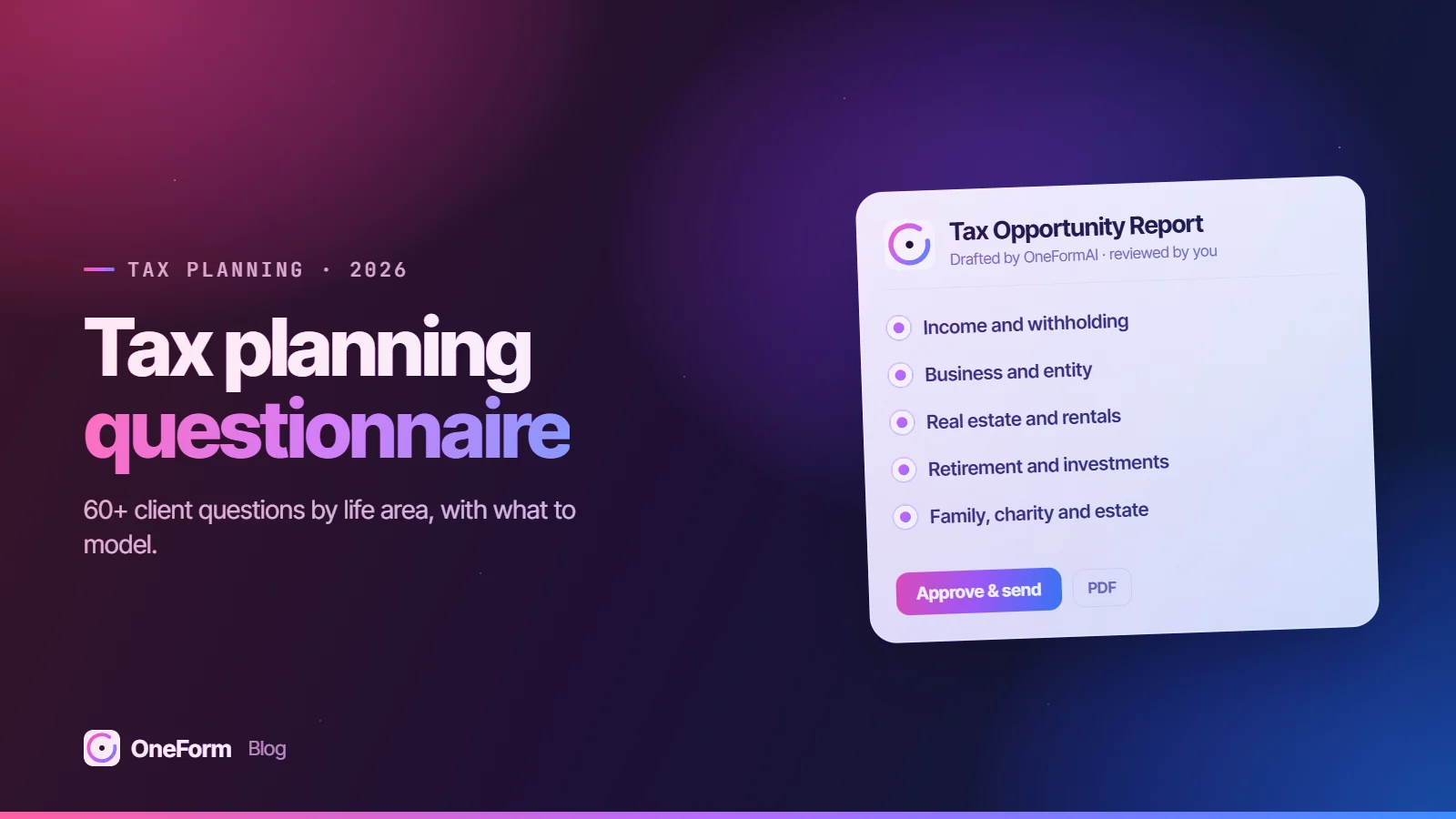
OneForm turns a questionnaire like this into a reviewed planning report. Start from the Year-End Tax Planning Checkup for clients or the Tax Opportunity Report for prospects, or upload your current questionnaire and let OneFormAI rebuild it with conditional logic.
- Each response produces an AI-drafted report written from your firm's own instructions. You edit and approve it, then send it as a branded PDF now or on a schedule.
- Clients who would rather talk can answer by voice; the transcript shows on screen and recordings are not kept.
- Workflows can alert your team on submit, wait for approval and log answers to Google Sheets or Slack.
- Drop-off analytics per question show which question to cut.
You can start free and adapt a template to your own question bank.
Frequently asked questions
What is the difference between a tax organizer and a tax planning questionnaire?
A tax organizer collects last year's documents and figures so the preparer can file an accurate return. A tax planning questionnaire asks about changes, intentions and upcoming decisions so the advisor can recommend actions before the year closes. Organizers go out in January; planning questionnaires go out mid-year and in early fall. Keeping them separate gets better answers to both.
How many questions should a tax planning questionnaire have?
Most clients should see 15 to 30 questions, even if the full bank holds 60 or more. Open with one screening question per life area, then use conditional logic so detailed follow-ups appear only when an answer signals an opportunity. A retiree and a business owner then get very different forms built from the same bank, and both stay short enough to finish.
When should I send clients a tax planning questionnaire?
Send it at least twice a year. A mid-year round between June and August leaves time for entity, payroll and retirement plan changes. A pre-year-end round in September or October drives December moves such as harvesting, charitable bunching and Roth conversions. Also send a short version within a few weeks of any major life event, such as a marriage, move or sale.
What should a tax planning questionnaire ask business owners?
Ask about entity type and when it was last reviewed, expected profit versus last year, owner salary if it is an S corporation, planned equipment purchases, employees and family members on payroll, retirement plans, accountable plans for reimbursed expenses, and any plan to sell or close the business. For 2026, also ask whether taxable income is near the $201,750 or $403,500 QBI threshold.
Can I use one questionnaire for individual and business clients?
Yes, if it branches. Put a screening question near the start, such as "Do you own all or part of a business?", and show the business section only after a yes. Shared sections such as household changes, retirement and giving apply to everyone, and one branching form is easier to maintain than separate versions.
This article is general information as of October 2026, not tax or legal advice. Confirm figures and how they apply to each client before acting.