To sell tax planning services, start with the compliance clients who have the most to gain. Show each one a specific opportunity in writing before you ask for a fee. Then offer a fixed-price plan with a defined scope, its own engagement letter and a follow-up calendar. Price the work on its value and quote the fee up front. Don't bill hours or take a share of the savings.
Key takeaways
- Tax planning sells best when the client has already seen a specific, written opportunity. A short questionnaire plus a findings report does that before the sales call.
- Start with the clients whose facts change most: business owners, S corporation shareholders, rental owners and households with a major income or life event.
- Package planning in two or three fixed-fee tiers with named deliverables, and keep it out of the compliance engagement letter.
- Don't price planning as a percentage of tax saved. Circular 230 §10.27(c)(1) counts a fee based on taxes saved as a contingent fee, and the AICPA Code and state boards have their own rules.
- Schedule follow-ups around dates the client already cares about, such as the four estimated tax installments under IRC §6654(c).
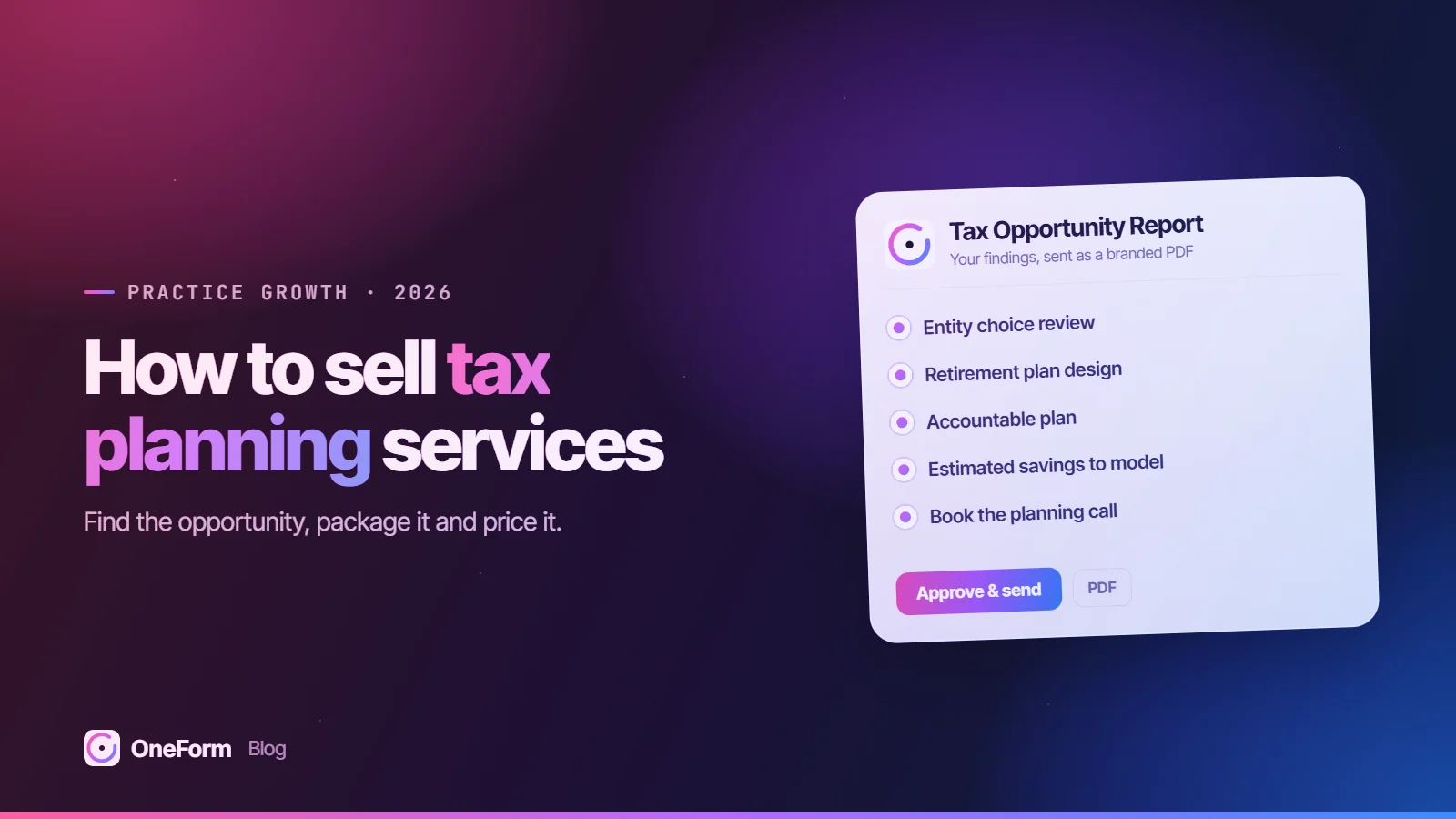
Let the questionnaire sell the engagement. With OneForm's Tax Opportunity Report template, every prospect gets a written, reviewed report of what's worth a closer look, and you can charge for it or book the call through your own Stripe account on every plan, Free included. Start free, no card needed.
What does selling tax planning services actually mean?
Proactive tax planning is a paid engagement. The firm reviews a client's facts before the year closes, recommends specific actions, estimates what each one is worth and follows up until they're done. Compliance reports what already happened. Planning changes what happens next.
Most firms already give planning away in the April meeting or a December call. Selling it means naming that work, scoping it, writing it down and charging for it.
For CPA and law firms, Treas. Reg. §301.7216-2(h)(1) generally lets the firm use a client's return information, and share it inside the same firm, to provide other accounting or legal services to that client. Disclosing that information outside the firm is a separate question with its own consent rules. We cover that in our guide to AI and section 7216.
Which clients should you offer tax planning to first?
Don't offer planning to everyone at once. Sort your client list by three things: how complex the facts are, how much they changed this year and whether the client can pay for advice. Clients who score high on all three are your first conversations.
| Client segment | Signal in last year's file | Typical planning topics |
|---|---|---|
| Sole proprietors and single-member LLCs | Rising net profit, no retirement plan, home office or vehicle use | Entity choice, retirement plan design, accountable plan, recordkeeping |
| S corporation shareholders | Low W-2 wages next to large distributions | Reasonable compensation, retirement contributions through payroll, owner health insurance |
| Real estate owners | New rentals, short-term rental activity, suspended passive losses | Material participation, depreciation and cost segregation, timing of sales |
| High-income W-2 households | Rising wages, equity compensation, large refunds or balances due | Withholding, Roth decisions, charitable timing, investment gains and losses |
| Clients with a life event | Business sale, inheritance, marriage, divorce, retirement | Timing of income, basis, estimated payments, filing status |
One question cuts through a lot of this: "How often do you meet with your accountant for tax planning?" A client who answers "never" and owns a profitable business is usually your best prospect.
How do you find the planning opportunity before the sales call?
The hardest part of selling planning is the first conversation. You're asking for a fee before the client has seen anything. Turn that around with a short questionnaire and a written findings report the client gets before the meeting.
Use a questionnaire that maps answers to opportunities
The Tax Opportunity Report template is a working example. It asks a business owner 16 short questions:
- Zip code, years in business, annual revenue and whether there are employees
- W-2 employees, 1099 subcontractors or both
- Whether they use an HSA and what retirement plan they have
- How often they meet with their accountant for tax planning
- Which legal entity they use
- Whether they track mileage, take the home-office deduction, deduct business meals and buy ongoing education
- How confident they are that deductions are maximized
Each answer points somewhere. "No retirement plan" plus solid revenue raises plan design. A sole proprietorship with steady profit raises the S corporation question. "No mileage app" raises substantiation. For more on question design, see how to build a tax planning questionnaire.
Turn the answers into a written findings report
A findings report is a short document listing the planning opportunities a client's answers suggest, why each might apply and what you'd need to confirm it. Keep it to three to five items. For each one, include:
- The opportunity, in plain language
- Why the client's answers suggest it
- What you'd need to confirm it (documents, numbers, facts)
- A dollar estimate only when you have the numbers to support it
- The next step, which is a planning meeting
A partner should review every report before it goes out. A findings report is written advice, so it has to rest on reasonable assumptions and the facts you actually have, as Circular 230 §10.37 requires. Say plainly what you haven't verified yet.
How should you package tax planning services?
Clients compare packages more easily than hourly rates. Two or three tiers with named deliverables give them a choice that isn't "yes or no."
| Tier | Fits | Deliverables | Meetings |
|---|---|---|---|
| Planning review (one-time) | New relationships and clients who want to test the value | Findings report, one projection, written plan summary with an action list | One |
| Annual plan | Most business owners and high-income households | Full projection, written plan, estimated payment updates, year-end action list | Two or three, including a fall year-end meeting |
| Year-round advisory | Multi-entity owners, fast-growing businesses, clients with transactions coming | Everything in the annual plan, quarterly projections, entity and payroll reviews, questions answered within scope | Quarterly, timed before installment dates |
Three rules keep tiers from causing scope creep:
- Name deliverables, not hours. "Written plan with an action list" is a deliverable. "Up to five hours" isn't.
- Say whether implementation is included. Setting up payroll, a retirement plan or an entity is separate work unless you say otherwise.
- Keep return preparation priced separately, so the client can see what planning costs on its own.
How much should you charge for tax planning?
We haven't included market fee ranges here. Most published averages come from vendor surveys with small or unclear samples. Your own numbers are better: how long a plan takes, what your best clients already pay and what a typical plan is worth to them. Choose a pricing method, then set the number from that data.
| Approach | How it works | Works best when | Watch out for |
|---|---|---|---|
| Value pricing | Fee set up front from the value of the work to the client, its complexity and your risk | The findings report already shows meaningful opportunities | The fee must not depend on whether savings actually happen |
| Fixed fee per plan | Same price for a defined deliverable in each tier | Clients look alike and the scope is repeatable | Complex clients squeezed into a simple tier |
| Subscription | Monthly or quarterly fee for a year-round package | Ongoing advisory with regular meetings | Unlimited-access promises with no scope limit |
Why not charge a percentage of the tax saved?
Circular 230 §10.27(c)(1) defines a contingent fee to include a fee based on a percentage of the refund or of the taxes saved. Section 10.27(b) limits when practitioners may charge one. Courts have narrowed how far that rule reaches, and the AICPA Code and state boards of accountancy have their own contingent-fee rules. Section 10.27(a) also bars unconscionable fees in matters before the IRS. A fixed fee quoted before the work starts, and owed whether or not the client acts on the plan, avoids all of that.
How do you answer fee objections?
| Objection | What's usually behind it | Response |
|---|---|---|
| "Isn't this included in what I pay you?" | Planning used to be free | Compliance reports the year that ended. Planning changes the year in progress. Show the deliverables side by side. |
| "What if it doesn't save me anything?" | Fear of paying for nothing | Point to the findings report they already have. The fee covers the analysis and the plan, and you don't promise a result. |
| "Can we just do this at tax time?" | Doesn't know about deadlines | Many planning moves have to happen before December 31. By April, the year is closed for most of them. |
| "It's too expensive." | Fee shown without context | Offer the one-time review as a smaller first step, then revisit the annual plan after the first meeting. |
| "Let me think about it." | No urgency | Send a written summary with the next deadline that matters to them, and book a follow-up date. |
What goes in a tax planning engagement letter?
Use a separate letter. The Journal of Accountancy advises firms to generally exclude tax consulting and tax planning from compliance engagements and to cover them in separate letters. The AICPA & CIMA Insights blog (November 2025) cautions against starting any work before the letter is signed. It also reports, citing CNA, that tax services accounted for 77% of the claims asserted against CPA firms in the AICPA Professional Liability Insurance Program in 2024.
- Parties and term. Who the client is (individual, entity or both) and the period covered.
- Scope. Which taxpayers, tax years and taxes (federal only, or named states).
- Deliverables. Projection, written plan, meetings, estimated payment updates.
- Out of scope. Return preparation, implementation, bookkeeping, representation and anything not listed.
- Client responsibilities. Timely, complete information, and telling you when facts change.
- Basis of advice. Advice relies on the facts provided and the law as of a stated date. Updates after law changes are covered only if the letter says so.
- Fees and billing. Fixed fee or subscription, when it's billed and what happens if scope changes.
- Consents. If you'll disclose return information outside the firm, get a separate written §7216 consent. For Form 1040 filers, Rev. Proc. 2013-14 lets you attach that consent document to the engagement letter.
- Technology. How you use software and AI tools, and that people review all work.
- Termination. How either side ends the engagement, and what's owed.
Have counsel review your template before you use it, especially the limitation and consent language.
How do you deliver the tax plan and keep clients engaged?
A plan that never gets carried out won't be renewed. Deliver it in the same order every time, and give every action an owner and a date.
- Send a data request scoped to the plan, not a full organizer.
- Build the projection and test the main recommendations against it.
- Hold the planning meeting and walk through each recommendation, its estimated value and its deadline.
- Send the written plan within a few days: a one-page summary, then the detail.
- Track each action item until it's done or the client declines it in writing.
- Review results at the next check-in and roll open items into next year's plan.
Time check-ins to dates the client already watches. Under IRC §6654(c), individual estimated tax installments are due April 15, June 15 and September 15, and January 15 of the following year. The IRS third-quarter tax calendar lists September 15, 2026 for the third 2026 installment, so the fourth falls on January 15, 2027.
| When | What | Owner |
|---|---|---|
| Before each installment date | Update the projection and the estimated payment amount | Staff preparer, reviewed by the planner |
| October to November | Year-end planning meeting and action list | Planner |
| December | Confirm year-end actions are done | Client service lead |
| February to March | Compare the plan to actual results and propose next year's tier | Planner |
Use the safe harbor when you set estimates. Under §6654(d)(1), the required annual payment is generally the smaller of 90% of the current year's tax or 100% of the prior year's tax. The prior-year figure becomes 110% when prior-year AGI was over $150,000 ($75,000 for married filing separately). For the year-end meeting agenda, see our year-end tax planning checklist.
How to run this with OneForm
OneForm turns forms into reviewed reports for accounting firms: forms in, reports out. You can put the Tax Opportunity Report questionnaire on your website as an inline form, a popup or a button. Each response can produce an AI-drafted findings report written from your firm's own instructions. You edit and approve the draft, then send it as a branded PDF now or on a schedule. Nothing goes out unreviewed unless you explicitly turn on auto-send.
- Report emails show opens and clicks, so you know who read their findings before you call. See reports.
- Leads are scored on fit (their answers) plus intent (opens, clicks, return visits), so you can call the right people first.
- Booking pages, and paid reports or paid calls through your own Stripe account, are available on every plan, Free Forever included. See plans.
- For the full setup for firms, see OneForm for accounting firms.
Start with the Tax Opportunity Report template.
Ready to try it? You can open the Tax Opportunity Report template or start free with OneForm. No card needed.
Frequently asked questions
How much should a CPA charge for tax planning?
There's no reliable published standard, and fees vary by market and client complexity. Base your price on your own data: hours per plan, what comparable clients already pay and the value a typical plan creates. Quote a fixed fee per tier before the work starts, with the deliverables for each tier named.
Can I charge a percentage of the tax savings?
It's risky. Circular 230 §10.27(c)(1) defines a contingent fee to include a fee based on a percentage of the refund or taxes saved, and §10.27(b) limits when practitioners may charge one. The AICPA Code and state boards of accountancy have their own contingent-fee rules. A fixed fee quoted up front and owed whatever the outcome is the cleaner approach. Check your state board's rules.
What should a tax planning report include?
A good planning report lists three to five specific opportunities. For each, it explains why it applies, what has to be confirmed, an estimated value when the numbers support one, the action needed, who owns it and the deadline. It should state the facts and assumptions it relies on, and the date of the law it reflects. A practitioner should review it before it goes to the client.
How do I transition compliance clients to tax planning?
Start with clients whose facts are complex and changing, such as business owners, S corporation shareholders and rental owners. Send them a short questionnaire, return a reviewed findings report and offer a planning meeting with two or three fixed-fee options. Use a separate engagement letter for planning. Tie follow-ups to estimated tax dates and the year-end meeting so the work stays visible.
Do I need a separate engagement letter for tax planning?
It's the recommended practice. The Journal of Accountancy advises firms to generally exclude tax planning and consulting from compliance engagement letters and to cover them in separate letters. A planning letter should define the scope, deliverables, exclusions, client responsibilities, the date of the law the advice relies on and the fee. Have counsel review your template.
How often should tax planning meetings happen?
At least once a year, before year-end, for annual plan clients. Year-round advisory clients usually meet quarterly, timed before the estimated tax installments under IRC §6654(c): April 15, June 15, September 15 and January 15 of the following year. Add a meeting whenever a major event comes up, such as a business sale, a new entity or a large equity grant.
This article is general information as of October 2026, not tax or legal advice. Confirm figures and how they apply to each client before acting.