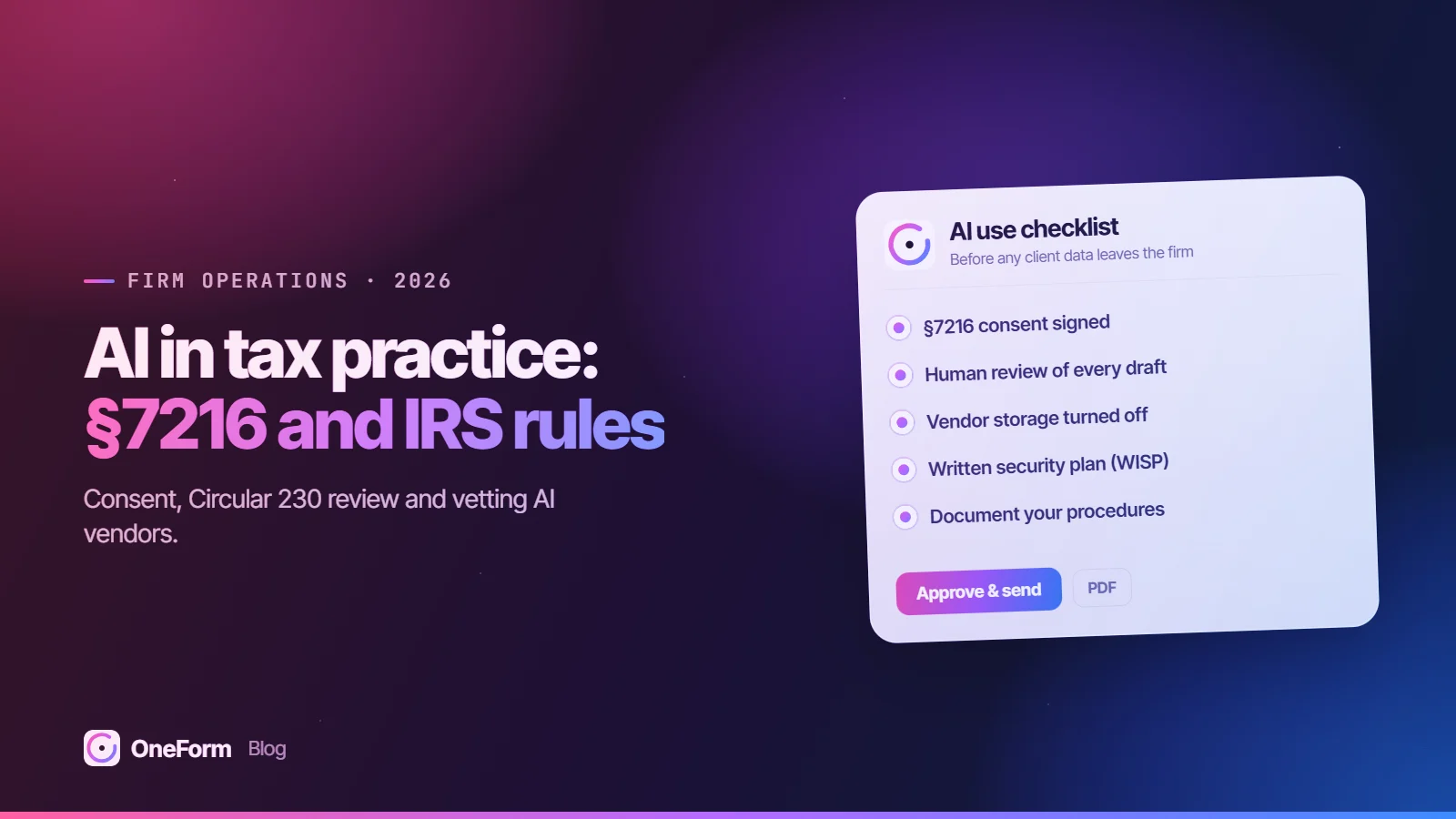
Tax firms can use AI to draft planning reports, summarize intake and write client emails, as long as they follow existing rules. Section 7216 limits how you use and disclose return information. Circular 230 requires a human to review every AI draft. The FTC Safeguards Rule requires a written security plan that covers your AI vendors. When in doubt, get a signed §7216 consent and talk to counsel.
Key takeaways
- Sending client return information to an outside AI service may be a disclosure under IRC §7216. Whether a service-provider exception covers it is unsettled, so many firms get written consent first.
- For Form 1040 filers, a §7216 consent must follow Rev. Proc. 2013-14: a separate document, mandatory statements and the taxpayer's signature. If it states no duration, it lasts one year from signing.
- The IRS Office of Professional Responsibility's June 24, 2026 guidance (Issue Number 2026-19) applies Circular 230 to generative AI. Review all AI output, verify facts and citations, vet vendors, document your procedures and bill fairly.
- Tax and accounting firms are financial institutions under the FTC Safeguards Rule, so AI vendors belong in the service-provider section of your written information security plan.
- Choose AI vendors that don't train on your data, keep storage off or short, and log access.
AI with a person in the loop. In OneForm, every AI-drafted report waits for your review and approval before it reaches a client, and AI calls are made with storage turned off at the provider. Start free, no card needed.
What rules apply when a tax firm uses AI?
No single rule covers AI in tax practice. Several existing ones overlap.
| Rule | What it covers | What it means for AI |
|---|---|---|
| IRC §7216 and §6713 | Criminal and civil penalties for unauthorized use or disclosure of tax return information by preparers | Whether you may send client data to an AI service at all |
| Treas. Reg. §301.7216-1 to -3 | Definitions, permitted uses and disclosures without consent, and consent requirements | Which exceptions might apply, and what consent must contain |
| Rev. Proc. 2013-14 | Format, mandatory wording and e-signatures for Form 1040 consents | How to write a valid consent for individual clients |
| Circular 230 and OPR Issue Number 2026-19 | Due diligence, fees, competence, firm procedures, written advice, confidentiality | Human review of AI drafts, vendor vetting, documentation, billing |
| FTC Safeguards Rule (16 CFR 314.4) | Written information security program, service-provider oversight, breach notice | Your AI vendor is a service provider you must vet and monitor |
| AICPA Code and SSTS | Client confidentiality, data protection, reliance on tools (CPAs) | A confidentiality contract or client consent before using a third-party provider, and responsibility for tool output |
What counts as tax return information under section 7216?
Tax return information is any information furnished in any form or manner for, or in connection with, the preparation of a tax return, including the taxpayer's name, address and identifying number (§301.7216-1(b)(3)). Intake answers, worksheets and information derived from them can all qualify.
The regulation restricts two acts. "Use" is relying on the information as the basis for an action. "Disclosure" is making it known to any person in any manner. Pasting a client's intake into a third-party chatbot is a textbook possible disclosure.
A knowing or reckless violation of §7216 is a misdemeanor punishable by a fine of up to $1,000 ($100,000 in identity-theft cases), up to one year in prison, or both. The civil penalty under §6713(a) is $250 per disclosure or use, capped at $10,000 per calendar year ($1,000 and $50,000 in identity-theft cases).
When do you need section 7216 consent to use AI?
Under §301.7216-3(a), unless §7216 or §301.7216-2 specifically permits a use or disclosure, the preparer needs the taxpayer's written consent first. The hard part is whether an exception fits your AI workflow.
Using information inside your own firm
Under §301.7216-2(c)(2), people in the same firm located in the United States may use and share return information to prepare the return or provide auxiliary services in connection with it. Under §301.7216-2(h)(1), a preparer lawfully engaged in the practice of law or accountancy may use the information, and share it inside the same firm, to provide other legal or accounting services to that client. That generally covers a CPA firm using a client's return to draft a planning report, but not sending the data to an outside AI provider.
The service-provider exceptions, and why their fit for AI is debated
Two provisions are often cited for outside vendors:
- Preparer-to-preparer, §301.7216-2(d)(1). You may disclose to another U.S.-based preparer to prepare the return or provide auxiliary services, "so long as the services provided are not substantive determinations or advice affecting the tax liability." The regulation defines a substantive determination as one that "involves an analysis, interpretation, or application of the law."
- Contractors, §301.7216-2(d)(2). You may disclose to a contractor for "programming, maintenance, repair, testing, or procurement of equipment or software" used for return preparation. The disclosure must be limited to what the contractor needs, and each person receiving the data must get written notice of §§6713 and 7216.
Neither was written for generative AI. An AI model drafting a planning memo arguably does the analysis of law that (d)(1) excludes, and (d)(2) is tied to return-preparation software, not planning advice. A 2023 Tax Notes analysis by Barclay Taylor suggests that loading data into a platform only the firm owns and controls might not be a disclosure at all, while sending it to a third-party platform likely needs consent. It also notes the regulations predate modern AI, last amended in 2008 and 2012.
As of October 2026, we haven't found IRS guidance under §7216 that creates an exception or safe harbor for AI tools. OPR's 2026 guidance, covered below, discusses §7216 risk but doesn't create one.
Practical options
- Send no client data out, or only data that can't be linked to a taxpayer. Derived information can still count as tax return information.
- Get a signed §7216 consent to disclose before any client data goes to an outside AI service, naming the recipient and purpose.
- If counsel concludes an exception applies, document why, limit the data and give the required written §§6713/7216 notice.
What does a valid section 7216 consent look like?
For any taxpayer, §301.7216-3 requires the consent to name the preparer and the taxpayer, state the purpose and recipients, specify the information involved, and be signed and dated. It must be knowing and voluntary, and you generally can't make your services conditional on it. It must be obtained before the disclosure or use, never after. If it doesn't state a duration, it's effective for one year from the date the taxpayer signed it.
For Form 1040 filers, Rev. Proc. 2013-14 adds strict format rules. Use this checklist:
- Put each consent in a separate written document. It may be attached to the engagement letter.
- Keep disclosure consents and use consents in separate documents. One document can cover several disclosures if the taxpayer affirmatively selects each one.
- Include the mandatory statements from section 5.04 in the prescribed order, including the one-year default duration.
- Include the TIGTA complaint statement required in every consent.
- Require opt-in. "Opt-out" consents, where the client deselects uses, aren't permitted.
- On paper, use at least 12-point type on 8½ by 11 inch or larger sheets, with a handwritten signature.
- Electronically, have the taxpayer type a PIN of at least five characters, their name, or five or more characters unique to them. The software can't prefill these.
- Add the required outside-the-U.S. statement if data may go to a preparer abroad. SSNs face added limits there.
- Never change a consent after signing, and don't leave blanks to fill in later. Give the client a copy.
Other taxpayers, such as corporations and partnerships, may use other formats, including an engagement letter, if the consent meets §301.7216-3.
What did the IRS say about AI in tax practice in 2026?
On June 24, 2026, the IRS Office of Professional Responsibility published "Issue Number: 2026-19. Introductory Guidelines for Responsible AI Use in Federal Tax Practice." Some commentators call it OPR Alert 2026-19. It doesn't create new rules. It applies existing Circular 230 provisions to generative AI:
- §10.22, due diligence. Thoroughly review all AI-created documents before they go to a client or the IRS, and verify facts, citations and calculations.
- §10.27, fees. Billing for time not actually spent, or double billing AI-assisted tasks, may violate the rule depending on the facts. OPR says cost savings should be passed on openly.
- §10.35, competence. Understand how the AI systems you use work, including their limits, risks and potential for bias or error.
- §10.36, firm procedures. Those responsible for the firm should have AI policies covering staff training, secure data handling and accuracy monitoring, and should vet outside AI tools, with all of it documented.
- §10.37, written advice. Don't rely on AI projections or statements without verification. If the system's logic is opaque, reliance may be unreasonable.
- §§6713 and 7216, and §10.51(a)(15). Handle client data only with secure, enterprise-approved AI. Willful mishandling may lead to discipline.
OPR's best practices add access controls, documented verification, a breach and error plan, staff training and treating AI text as a draft. For CPAs, AICPA SSTS section 1.4, Reliance on Tools (effective January 1, 2024), points the same way. The Tax Adviser notes that it names AI as a tool and that using a tool doesn't relieve the member of professional responsibility.
What human review looks like in practice
- A partner writes or approves the instructions the AI follows for each type of document.
- Staff send only the data the task needs and mask SSNs and account numbers.
- The reviewer checks every fact against source documents, every citation against the primary source and every number against a calculation.
- The reviewer removes anything they can't verify, then approves, and the system records who approved it and when.
- The firm keeps the final version and the review record with the client file.
How does the FTC Safeguards Rule apply to AI tools?
The IRS reminded practitioners in IR-2026-92 (August 18, 2026) that tax and accounting professionals are financial institutions under the Gramm-Leach-Bliley Act and are legally required to have a written information security plan (WISP). Under the FTC Safeguards Rule, 16 CFR 314.4, that program must:
- Limit access to authorized users, encrypt customer information in transit and at rest, require multi-factor authentication and log user activity.
- Generally dispose of customer information within two years after its last use, unless it's still needed.
- Select service providers that can protect the data, require safeguards by contract and assess them periodically (§314.4(f)).
- Include a written incident response plan, and notify the FTC within 30 days of discovering an event involving 500 or more consumers.
Add every AI tool to your WISP's service-provider list. The IRS resources are Publication 5708, Creating a Written Information Security Plan for your Tax & Accounting Practice, and Publication 4557, Safeguarding Taxpayer Data. CPAs should also note AICPA Interpretation 1.700.040. As the Journal of Accountancy explains, it requires either a confidentiality agreement with a third-party service provider or the client's specific consent before you disclose confidential information to it.
What should you check before choosing an AI vendor?
Get answers in writing and file them with your WISP.
| Check | What to ask | Why it matters |
|---|---|---|
| No training on your data | Are prompts or outputs used to train or improve models? | OPR warns that data from one client can spill into answers for another |
| Retention off or short | Is storage of prompts and responses off? Is anything kept for abuse monitoring, and for how long? | Less stored data means less exposure, and the Safeguards Rule requires disposal |
| Confidentiality contract | Will you sign terms that keep our data confidential and require safeguards? | 16 CFR 314.4(f)(2) and AICPA 1.700.040 |
| Access controls | Single sign-on, MFA, role-based access, staff offboarding | Access limits and MFA are required safeguards |
| Encryption | Is data encrypted in transit and at rest? | Required unless a compensating control is approved |
| Audit trail | Can we see who generated, edited, approved and sent each document? | OPR asks firms to document AI use and verification |
| Data location and subprocessors | Where is data processed, and by whom? | Disclosures to preparers outside the U.S. need consent, and SSNs face extra limits |
| Breach notice and deletion | How fast will you tell us about an incident? Will you delete our data when we leave? | Feeds your incident response plan and FTC notice clock |
How to run this with OneForm
OneForm turns client forms into reviewed reports, with a person in charge of every draft. Each response can produce an AI-drafted report written from instructions your firm writes. Your team edits and approves it before it goes out as a branded PDF. Nothing is sent unreviewed unless a firm explicitly turns on auto-send. Given OPR's guidance, most firms should leave it off. AI calls are made with data storage turned off at the AI provider (store: false).
- Draft planning reports and intake summaries from your own instructions with reports.
- Let clients answer by voice with voice forms. The transcript shows on screen, and recordings aren't kept.
- Review how data is handled on the security page, and add OneForm to your WISP's service-provider list.
OneForm doesn't provide or manage §7216 consents. Handle consent in your own engagement process, as described in our client onboarding guide, and ask counsel whether your workflow needs it. If you're using AI-drafted findings reports to sell planning, see how to sell tax planning services. Start free.
Frequently asked questions
Do I need a 7216 consent to use AI with client tax data?
Possibly. Using return information inside your own firm is often permitted without consent. Sending it to an outside AI provider may be a disclosure, and whether the service-provider exceptions in §301.7216-2(d) cover AI is debated. As of October 2026, we haven't found IRS guidance creating an AI exception. The conservative course is a signed consent naming the provider and purpose, and a conversation with counsel.
How long is a section 7216 consent valid?
As long as the consent says. If it states no duration, it's effective for one year from the date the taxpayer signed it, under Treas. Reg. §301.7216-3(b)(5). For Form 1040 filers, Rev. Proc. 2013-14 requires the consent itself to say so in its mandatory statements. Consent must be obtained before the disclosure or use, can't be retroactive and generally can't be a condition of preparing the return.
What is OPR Alert 2026-19?
It's how commentators refer to the IRS Office of Professional Responsibility's June 24, 2026 publication "Issue Number: 2026-19. Introductory Guidelines for Responsible AI Use in Federal Tax Practice." It applies existing Circular 230 rules to generative AI: due diligence (§10.22), fees (§10.27), competence (§10.35), firm procedures (§10.36), written advice (§10.37) and confidentiality of return information. It calls for human review of all AI output.
Can CPAs use ChatGPT for tax work?
Yes, with care. OPR says practitioners should handle client data only with secure, enterprise-approved AI, never upload sensitive data to unsecured sites, and treat AI output as a draft to be verified. Public tools without a confidentiality contract or data controls create §7216, Safeguards Rule and AICPA confidentiality risk. General research questions that contain no client data carry much less risk.
Do tax preparers need a written information security plan?
Yes. In IR-2026-92 the IRS says tax and accounting professionals are financial institutions under the Gramm-Leach-Bliley Act and are legally required to have a written, accessible security plan. The FTC Safeguards Rule sets the required elements, including oversight of service providers such as AI vendors. IRS Publication 5708 provides a template, and Publication 4557 covers safeguards.
This article is general information as of October 2026, not tax or legal advice. Confirm figures and how they apply to each client before acting.